|
Size: 45029
Comment:
|
Size: 45029
Comment:
|
| Deletions are marked like this. | Additions are marked like this. |
| Line 313: | Line 313: |
| * 725 Earth Kingdom cash | * 665 Earth Kingdom cash |
Y. denotes words in the Yonggan language, C. for the equivalents in the Central Earth Kingdom language. |
Princess Mukushen (Y/C. 穆庫什 Mùkùshén), b. 0081-08-18 AG (Year of the Ox, Earth Kingdom date 永無5年8月18日), is a young noble of the Nara clan, and an imperial kinswoman of the deposed Great Ri dynasty. She was born in the Hanwang desert of the Northern Earth Kingdom, where her clan were banished after their support for Qin the Great in the Earth Kingdom civil war. As a teenager, she was forced to flee from her home when political violence within the Nara clan resulted in the deaths of her parents.
Name and Title
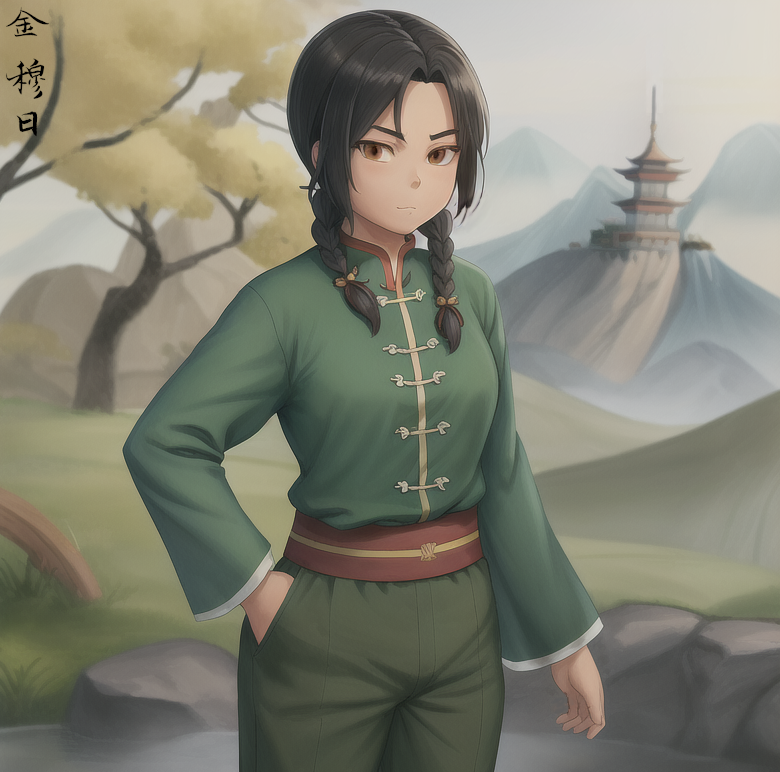
Portrait of Mukushen, age 14, by an artist of the Fire Nation colonies.
Mukushen was born to the Aisin (Y. 愛新 Aisin, C. 金 Jīn) family of the Nara (Y. 納喇 Nara, C. 日 Rì) clan of the Yonggan people. Her semi-nativized name in the Central Earth Kingdom language, with a compound surname, is Rijin Mukushen (日金·穆庫什), and this is what would appear on official records and documents concerning her, e.g. passports (however, being an internal exile, she does not have a passport.) She sometimes uses a completely-nativized Earth Kingdom name, Muri JIN (金穆日 "Reverent-Day Gold"), which she made up with her language tutor; Jin is a relatively common Earth Kingdom name with the same meaning as Aisin. Sometimes she uses an alias with the same pronunciation but characters not associated with her exiled clan, 珒睦囸 "Harmonious-day Jade." Traditionally, though, the Yonggan do not use surnames as such, and it would be strange to address Mukushen by her family or clan names in the Yonggan language. However, under the influence of the Earth Kingdom culture, most Nara are familiar with and accept the concept of surnames in Earth Kingdom contexts.
Mukushen's full title, omitting titles that she might theoretically hold but have never been operative in her lifetime, is: The Imperial Princess Mukushen of the Noble House of Aisin. (愛新朝之穆庫什帝國公主)
As a descendent of the father of the founder of the Ri dynasty, she is specifically a princess of the imperial blood, and as a direct male-preference primogeniture descendant of the Imperial Prince of Jin, the title she passes on to her heir will be undiminished in rank, making hers a so-called granite noble rank.)
Among the Nara (and other Yonggan who might recognize her nobility) she would generally be addressed as gege ("princess," or a high ranked noble female more generally) rather than by a personal name, except by her family and friends. However, among the cosmopolitan Earth Kingdom culture, she goes by her assimilated name.
Mukushen does not yet have a courtesey name or an art name per se, though she does use the name Muri for her thus-far modest literary output in the Common language.
Ancestry
The Aisin family descend from the Prince of Jin, younger brother of the first Ri monarch of the Earth Kingdom and one of the conquest elite of the then-new dynasty. As she has no brothers and the Yonggan use male-preference primogeniture, with the death of her father, Mukushen is the de jure heir to the Principality of Jin, northeast of Ba Sing Se. However, her family lost control of these lands during the twilight years of the Great Ri. They lost their remaining holdings in traditional Yonggan lands after the Nara clan supported Qin the Great in his ultimately unsuccessful rebellion against the Hao-Ting dynasty that had supplanted the Great Ri centuries prior.
Descent of the Imperial Prince of Jin |
|
Name |
Lived |
Pretty Obviously Mythic History |
|
The Great spirits of the Earth and Fire (Na and Tuwa) begat Shun (Sun) and Togho (Volcano). Their daughter Shun was taken by Edun to provide warmth for Heaven. Shun fell in love with her half-sibling, a mountain spirit (born of Na and Edun, but which mountain is disputed), and bore him the spirit Antu. Antu met a human woman Sargan in the mountains and fathered Barutu with her. Barutu is the mythic ancestor of all Yonggan people; his brother Gaihasu is ancestor of the Abka. (Which is firstborn is disputed.) |
|
Possibly Mythic History |
|
納喇·主, 日主 Lord Nara |
f. 2100 BG |
Yonggan culture hero, the son of Barutu and Ikirihan (a spirit, supposedly), shrouded in myth though the name is mentioned in contemporary records. He and his male and female siblings are each the mythical patriarch or matriarch of a Yonggan clan. |
|
(35 generations of partly-mythical history here) |
|
Unification of the Yonggan |
|
納喇·嘉瑪喀 NARA Jiamaka |
910? - 860 BG |
An ambitious Nara beile who was a famed warrior. |
|
納喇·納齊布祿 NARA Nacibulu, Luminous Khan |
887-808 BG |
納喇·寶實 NARA Boosi, Yonggan Khan of Khans |
863 - 801 BG |
Unified the Yonggan under Nara leadership, becoming the first Khan of Khans (khagan). |
|
納喇·界堪 NARA Jaikan, Yonggan Khan of Khans |
840 - 761 BG |
A vassal of the 15th Earth King, whose army was invited into Ba Sing Se to help end a rebellion. Which, to be fair, he did do. Made his eldest son the 16th Earth Monarch. |
|
Nara Ascendency - The Great Ri Dynasty (大日朝) |
|
納喇·愛新 Nara Aisin, Imperial Prince of Jin |
821 - 754 BG |
Younger brother of the 16th Earth Monarch, who was the founder of the Great Ri dynasty |
|
愛新納喇·覺昌安 AISIN-NARA Giocangga |
799 - 717 BG |
愛新納喇·瑠闡 AISIN-NARA Liocan |
770 - 704 BG |
愛新納喇·外兰 AISIN-NARA Wailan |
739 - 669 BG |
愛新納喇·包朗阿 AISIN-NARA Boolangga |
715 - 662 BG |
The Nara after the Fall of the Great Ri |
|
愛新納喇·布干 AISIN-NARA Bugan |
687 BG - 607 BG |
Remained enfeoffed prince of the Western Yonggan lands after the end of the Great Ri in 620 BG by pledging loyalty to the new Hao-Ting dynasty Earth King. |
|
愛新納喇·福满 AISIN-NARA Fuman |
661-599 BG |
Had no sons; passed his title to his eldest daughter. |
|
愛新納喇·慈禧 AISIN-NARA Cixi |
640-539 BG |
愛新納喇·錫寶齊 AISIN-NARA Sibeoci |
623-543 BG |
Was never reigning Prince because his mother outlived him. |
|
愛新納喇·阿古 AISIN-NARA Agu |
600-552 BG |
Was never reigning Prince because his grandmother outlived him (he died in battle) |
|
愛新納喇·褚宴 AISIN-NARA Cuyan |
576-503 BG |
愛新納喇·圖賴 AISIN-NARA Tulai |
550-467 BG |
愛新納喇·載灃 AISIN-NARA Zaifeng |
522-463 BG |
愛新納喇·溥倛 AISIN-NARA Puqi |
482-410 BG |
Was third brother; First brother died childless after becoming prince and second brother was intellectually disabled and also childless |
|
愛新納喇·(小)界堪 AISIN-NARA Jaikan the Younger |
457-380 BG |
Had no sons; passed title to daughter Youlan |
|
愛新納喇·幼蘭 AISIN-NARA Youlan |
432-361 BG |
愛新納喇·奕譞 AISIN-NARA Yixuan |
404-370? BG |
Went missing; date of death unknown |
|
愛新納喇·阿台 AISIN-NARA Atai |
383-315 BG |
愛新納喇·塔克世 AISIN-NARA Taksi |
369-312 BG |
愛新納喇·舒爾哈齊 AISIN-NARA Suerhaqi |
351 BG - 274 BG |
愛新納喇·濟爾哈朗 AISIN-NARA Jierhalang |
330 BG - 265 BG |
Jierhalang supported Qin the Great in his rebellion against the Earth King. He killed himself after death of Qin the Great. |
|
Kyoshi’s Era 垣正 Yuanzheng |
|
愛新納喇·孟特穆 AISIN-NARA Mengtemu |
302 BG - 264 BG |
Executed by the Earth Kingdom for his participation in Qin’s rebellion. |
|
愛新納喇·太杵 AISIN-NARA Taiku |
285 BG - 264 BG |
Executed by the Earth Kingdom for his participation in Qin’s rebellion. |
|
The Nara in Exile |
|
愛新納喇·(老)扈尔罕 AISIN-NARA Hurhan (the elder) |
265 BG - 234 BG |
First of the line to be exiled (for his participation in Chin’s rebellion.) |
|
愛新納喇·玉衡 AISIN-NARA Yuheng |
243 BG - 162 BG |
Eldest daughter of Hurhan the elder, inherited his title because he had no son. She passed it onto her son Ahachu. Yuheng was born in exile in the Hanwang desert. |
|
愛新納喇·阿哈出 AISIN-NARA Ahachu |
225 BG - 159 BG |
愛新納喇·妥罗 AISIN-NARA Tolo |
203 BG - 151 BG |
愛新納喇·塔克世 AISIN-NARA Taksi |
170 BG - 109 BG |
愛新納喇·克什纳 AISIN-NARA Keshina |
143 BG - 81 BG |
Killed in political violence. |
|
愛新納喇·(小)扈尔罕 AISIN-NARA Hurhan (the younger) |
118 BG - 81 BG |
Killed in political violence. |
|
愛新納喇·满泰 AISIN-NARA Mantai |
95 BG - 21 BG |
Roku’s Era, 焯光 Zhuoguang |
|
愛新納喇·珠舍哩 AISIN-NARA Jusheri |
76 BG - 3 AG |
愛新納喇·訥殷 AISIN-NARA Neyin |
55 BG - 11 AG |
愛新納喇·(老)跋海 AISIN-NARA Bahai (the elder) |
30 BG - 49 AG |
Era of the 氜武 Yangwu Air Nation Avatar |
|
愛新納喇·綏可 AISIN-NARA Suike |
2 - 40 AG |
愛新納喇·外兰 AISIN-NARA Wailan |
25 - 92 AG? |
Oldest personally known to Mukushen. Went missing while being the incumbent khan of the Nara. |
|
愛新納喇·(小)跋海 AISIN-NARA Bahai (the younger) |
51 - 94 AG |
Killed in political violence after killing Aiyin Nara Tolo, who proclaimed himself khan. Was heir apparent to the khanate but denied that Wailan was dead, so never claimed the title. |
|
愛新納喇·穆庫什 AISIN-NARA Mukushen |
81 AG - |
Fled Nara society to avoid being killed by the Aiyin family and their allies. |
|
Names are as transcribed in the relevant volumes of the Veritable Records of the Great Ri or the Register of the Imperial Nara Kinfolk, in its Hanwang recension. (Names in common logophonetic characters are written in phonetic transcription.)
Early Life
Mukushen was born in the oasis town of Manyuequan, in the Hanwang Desert, eighty-one years after the Air Nomad genocide began and in the tenth year of Earth King Kuei. Her birth there was not planned, as her exiled people were not legally allowed to be there overnight, and as a consequence her mother gave birth secretly in a common inn (the Yellow Pillar Inn), alone except for a handmaid and the midwife. Her father only got to see his first child in the morning, when the Nara were allowed back in to the town.
Mukushen was born to a life of relative privilege, though she and her family were very conscious of just how far they had fallen during their exile and, indeed, since the glory days of the Great Ri. Her household was semi-nomadic, shifting hunting grounds for their dwarf badgermole herd four times a year through the Hanwang desert and portions of the badlands included in the pale of banishment. They lived in an Ukdun, a traditional circular Yonggan dwelling constructed with earthbending. Her father, Bahai the Younger, was the eldest son and heir apparent to the Luminous Khanate of the Nara, and her mother was his secondary wife, GIAO-NARA Sain, a mantic priestess and earthbender. Mukushen was the firstborn, arriving a year after Sain and Bahai were married. The birth was difficult for Sain and she was advised to avoid subsequent pregnancies, which she and Bahai reluctantly accepted. Bahai resisted pressure from his father to take a third wife and attempt to produce a son.
Mukushen had a wet nurse, MOGIYA-NARA Hojo, in keeping with the tradition of Nara families of high rank, who typically turned their infants over to wet nurses after a week or two. In Mukushen's case, Hojo had to feed her right away, as Sain's milk production was very poor due to her weak state of health after the delivery. Hojo nursed Mukushen until the age of six and half, also the typical practice for highborn Nara children.
As a child, Mukushen was noted to be intelligent and precocious. She was able to read the (phonetic) Yonggan script at the age of four, and could speak two dialects of the Central Earth Kingdom language (Ganjinese and the Hanwang dialect spoken by some of the Nara's retainers) in addition to her native language. She was noted to be an earthbender at the age of five, and her mother began her first training in Yonggan earthbending. Her formal schooling, with tutors, began at the age of six. She learned the Common Lanugage from her tutors and began to learn the common phono-ideographic written language of the Earth Kingdom as well.
Though Wailan khan tried to gently pressure her father into taking a third wife, he never did, and Wailan accepted that Mukushen would be heir to his princely title, with the khanate expected to eventually pass to his younger son's family instead, which already included a grandson, AISIN-NARA Sholantu. Wailan did not want the titles to be divided, but did not feel that the clan council would allow a female to inherit the khanate (whereas female inheritance of the princely title was well-established.) He, and later his wife, provided generous financial support for the education of both Mukushen and her cousin Sholantu.
Shortly before Mukushen's 7th birthday, her grandfather Wailan khan went missing, having walked into the desert at night for unclear reasons. Despite an intensive search, he was not found, and his disappearance remained a mystery. Bahai resisted suggestions that he should ask the clan council to declare the luminous khan to have died or even just abdicated, and continued to conduct himself as the heir apparent. In this unusual state of affairs, allies were frustrated and rivals saw opportunity; Mukushen's family made little attempt to shield her from the realities of Nara politics.
Mukushen continued to be an apt pupil of her tutors. Her mother noticed that Mukushen was even picking up some sandbending from the family's retainers. Being more open than most Nara to the idea that the Sandbender tribes common to the deserts of the Earth Kingdom might know something useful about Earthbending, she even arranged for a sandbender woman to tutor Mukushen in sandbending. (Most of the sandbender tribespeople stigmatize close association with the Nara, but she was in desperate circumstances and generous compensation was offered.)
At age ten, Mukushen was initiated as an acolyte in the Nara religious tradition of which her mother was a priestess. By this point, Mukushen was recognized as an earthbending child prodigy (神童) among the Nara, and her grandmother also hired a Yonggan earthbending master, LU JALA Taksi, to help train Mukushen in latest developments in the Great Northern Earthbending Way. This was at considerable expense, since Taksi did not like living in the desert and requested large sums of money. Mukushen did not get along with him at first, somewhat resenting his disciplined regimen, but eventually accepted its usefulness and was able to benefit from it substantially.
Adolescence and Further Education
At 11, Mukushen's studies in earthbending had progressed to such an extent that she attained the Quartz degree, under the tuteledge of Taksi and an ethnic Central master named MAO Leping. This was unusual as that degree is seldom attained before the age of 16.
At 12 years of age, Mukushen was betrothed to AIYIN-NARA Elden, eldest son of AIYIN-NARA Tolo, a prominent Nara noble and Granite Duke, his family descended from the conquest elite of the Great Ri. Mukushen liked Elden, though relations between their families were somewhat frosty, and the betrothal proved to be an unsuccessful attempt by her father and the aging Aiyin patriarch to improve them.
Shortly after her betrothal, Mukushen was initiated as a mantic priestess and began more intense studies in ritual, sacrifice and divination with the Imperial High Priestess GIAO NARA Ulhichun. AISIN NARA Mengtemu, a scholar and distant cousin, taught her the history of the Earth Kingdom from the classic Histories, and also instructed her in geomancy.
As the girl had shown an interest in the culture and political history of the Earth Kingdom, TONG Zhen, an itinerant scholar who grew up in Ba Sing Se, was also hired to teach her about contemporary Earth Kingdom culture. He was also avidly following the progress of the Hundred Years War and developments in Fire Nation and Earth Kingdom military technology. A political dissident expelled from Ba Sing Se university, Zhen was keen to impart his opinions on when and how the incumbent dynasty had gone wrong to his student.
When she turned 13, Mukushen attained the Topaz degree in the Great Northern Earthbending Way, pleasing her parents and her earthbending masters tremendously.
Mukushen enjoys literary composition, both in her native Yonggan language and in the Common classical/literary language of the Central Earth Kingdom. She has written many short poems on such topics as: learning bending; the desert; historical figures of the Yonggan, wider Earth Kingdom, and antebellum Fire Nation; badgermoles (and hers in particular); and the sandbenders, inspired by her sandbending tutor's stories. The latter attracted minor controversy with the conservative Nara elite because they were perceived as portraying often-hostile barbarians in too positive a light.
Being very occupied with her studies and encouraged by her senior mother (i.e. ARU-NARA Yuheng) to remain aloof from ordinary Nara children, Mukushen had no close friends apart from her cousin and milk-sister MOGIYA-NARA Muke. Although they lived in the same household, Muke was a commoner of mixed ethnic descent and Yuheng somewhat disapproved of the girls' friendship.
Household Composition during Mukushen's Early Adolescence
Household of AISIN-NARA Bahai (heir apparent of the luminous khanate) |
|||||
Name |
Relation |
Status |
Ethnicity |
Occupation |
Age |
AISIN-NARA Bahai |
self |
noble |
Yonggan |
prince, hunter, warrior, nobleman |
49 |
ARU-NARA Yuheng |
paramount wife |
noble |
Yonggan |
noblewoman, scholar |
46 |
GIAO-NARA Sain |
secondary wife |
noble |
Yonggan |
mantic priestess, noblewoman, earthbender |
34 |
AISIN-NARA Mukushen |
daughter by secondary wife |
noble |
Yonggan |
mantic priestess, earthbender, noble child (betrothed) |
14 |
AISIN-NARA Sholantu |
son of younger brother |
noble |
Yonggan |
unmarried noble child (betrothed) |
13 |
LIN Weichun |
retainer |
free |
Ganjinese |
tutor to Mukushen and Sholantu, Northern Way (Ganjinese school) earthbender |
62 |
WEI Zhu |
steward |
eunuch retainer |
Central |
chief steward, herald, butler |
54 |
ERTU-NARA Erdeni |
retainer |
free |
Yonggan |
Guard, sand/earthbender |
24 |
MOGIYA-HAMA Sahaliyan |
retainer |
free |
Yonggan/Sandbender tribesman |
Guard, sandbender, hunter |
19 |
MOGIYA-NARA Hojo |
retainer |
free |
Yonggan/Central |
Wetnurse, ritual assistant |
31 |
MOGIYA-NARA Muke |
retainer |
free |
Yonggan/Central/Beetle-Helmet Person |
daughter of Hojo, maid, milk-sister of Mukushen |
14 |
DURE-NARA Neyin |
bondservant |
unfree |
Yonggan |
cook, hunter |
25 |
DURE-NARA Fodo |
bondservant |
unfree |
Yonggan |
maid, younger sister of Neyin |
20 |
TONG Yuanyuan |
bondservant |
unfree |
Southern |
maid, animal tender (no relation to Mukushen's tutor of the same surname) |
16 |
The household lived in an ukdun, a type of dwelling constructed with earthbending. Theirs was fairly large and took a few hours to construct even though the household included several earthbenders and sandbenders, besides trained badgermoles. The design varied depending on the season.
Despite their nomadic lifestyle, Mukushen's home was richly furnished with items passed down through the generations from her illustrious ancestors. The whole affair would be moved four times a year as the Nara moved to new hunting grounds for their badgermoles. Some of the items of furniture and household goods were in poor repair after over 300 years of heavy use and expedient repair by a group that initially had few craftsmen. It also included some imported items of recent manufacture, such as mantle lamps manufactured in the Fire Nation colonies and some household items and stationary made in Ba Sing Se; these were purchased with princely tax revenue and proceeds from badgermole sales.
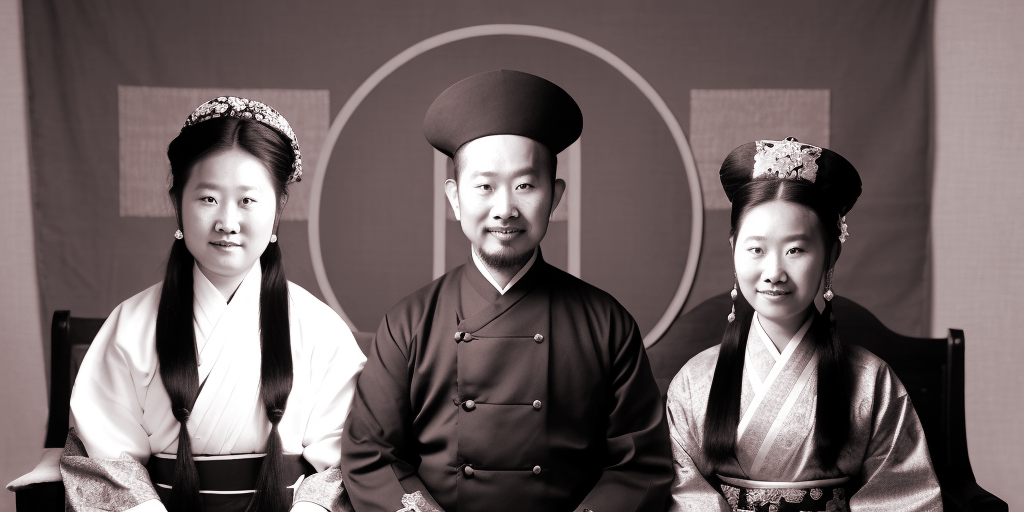
Imperial Nara Prince in Exile and his Wives, by S. Takeharu, an itinerant photographer from Yu Dao. Mr. Takeharu spent several years traveling in the Northern Earth Kingdom with a portable darkroom. Left-to-right: GIAO-NARA Sain; AISIN-NARA Bahai, the Prince of Jin; ARU-NARA Yuheng. Taken about 90 AG.
Flight from the Nara Clan
In 94 AG, the Aiyin family patriarch died, passing his title to his son Tolo. Tolo then addressed the clan council a few days later on 0094-08-28 and requested that he be acclaimed khan, since Wailan was dead and his son Bahai refused to accept this fact. Although the council seemed unlikely to grant the request, the suggestion was taken seriously and it was clearly with some support. Though not of the Imperial blood, Tolo was a popular and generous nobleman. As discussions were taking place, Mukushen's father Bahai struck down Tolo in the council chambers, enraged by the insistence that Wailan was dead. A fight ensued, in which Bahai and several counselors who had been arguing against accepting Tolo's claim were all killed. Tolo was acclaimed khan, with questionable regularity, but his wounds were mortal and he died that night. The rump clan council allowed his son Elden to succeed him.
Mukushen was at home during the council meeting, attempting to train her dwarf badgermole, Shu. At the council, however, was her older cousin, Yeyun, who ran back to warn Wailan's wife/widow Bumbutai. Bumbutai was able to persuade Mukushen to flee, entrusting her with some important cultural objects belonging to the late khan. The Aiyin khan's supporters attacked Mukushen's home, killing Bahai's wives and Bahai's faithful eunuch steward, WEI Zhu; Wailan's household was also attacked, with Mukushen's grandmother Bumbutai and uncle being killed. Although Mukushen acted on the instruction of her grandmother, she nonetheless is ashamed that she did not immediately avenge her family. Mukushen hid in the desert for a day, before sneaking back, only to find that the Aiyin had consolidated power and installed the fifteen-year-old boy to whom she was betrothed, AIYIN-NARA Elden, as khan under a regency; her cousin Sholantu had survived by renouncing his claim to the khanate. Her milk sister, Muke, was moved to Sholantu's household; Mukushen spoke to her briefly but she did not want to leave her injured mother to join Mukushen in fleeing.
Mukushen paid a clandestine visit to the house of the high priestess GIAO NARA Ulhichun, who had supervised her religious education, only to find that Ulhichun had been put to death after making unfavorable predictions about the new khan. While Mukushen was "recovering" some further important religious and cultural objects from Ulhichun's former residence, she was discovered by a pair of guards loyal to the Aiyin Nara. Not desiring to give up the objects (or be captured and possibly executed by the Aiyin) she fought them with her earthbending. One of the guards, IRGEN NARA Jiamaka was definitely killed, but the other survived and informed the usurper khan about the incident. Mukushen again escaped into the desert, and found her way to a Beetle-headed merchant caravan, which she joined as a mercenary earthbender to earn a living. With the beetle-headed merchants, she concocted a non-Nara backstory for herself, claiming to be an ethnic Yonggan but of the Aisin Jala family (which is actually extinct in the present day). She goes by her Earth Kingdom name Muri JIN among them, though, rather than as Mukushen of the "Aisin Jala." This transitional phase of her life lasted only a few weeks, however - while visiting a shrine on the outskirts of Ganjingguo, Mukushen had a spiritual experience which caused her to believe that she needed to find the Avatar, in order to end the Hundred Years War.
Thereafter, she struck out on her own and illcitly conducted the geomantic rituals used by the Earth Sages of the Great Ri to find the Avatar, these being set forth in a book given to her by Ulhichun. These rituals needed to be conducted at specific numinous places, and most of them involved trespassing in abandoned Earth Sage shrines shuttered by the Hao Ting. Eventually, her geomancy led her to an unexpected candidate...
Continuing Interest of the AIYIN-NARA in Mukushen
The Aiyin are actively seeking to return Mukushen to Nara society for several reasons - to face justice for her murder and assault of the Aiyin's guards at Ulhichun's house, and to recover the important records and cultural objects she was given or stole. Nara clan law is also unclear on the circumstances under which a betrothal can be unilaterally dissolved, and although they can guess Mukushen's feelings about marrying Elden at this point, they do not have an official statement renouncing the arrangement from the Aisin. (The Aisin patriarch recognized by the Aiyin in the aftermath of the late political violence is Mukushen's cousin Sholantu, who is a minor and unable to dissolve the contract on her behalf.) However, the surviving clan elders agree that if Mukushen were dead, Elden could take another bride as his paramount wife. (Nara high nobility sometimes practice polygamy, but the betrothal contract between the Aisin and Aiyin specifically says that Mukushen will be Elden's paramount wife, in case he should happen to take another bride before their official wedding; obviously being freed of this constraint makes him a much more attractive prospect.)
Elden himself actually still likes Mukushen and absolutely does not want her to be captured and killed; however, his regency are unlikely to take his feelings on the matter into account overmuch as they would hardly permit him to marry for love given Mukushen's apparent political uselessness to the Nara at this point in her life.
Shu the Dwarf Badgermole
Mukushen has a dwarf badgermole of her own, named Shu. Badgermoles take up to a decade to reach maturity, and Shu was given to Mukushen on her tenth birthday, as a yearling (making him now 5 years old.) Shu stands about 1m high at the arch, and is considered too small to ride. (Mukushen is a relatively large girl and badgermoles have spinal biomechanics unsuited for riding unless they are much larger in proportion to the rider.) However, he is still useful as a pack animal, and carries most of Mukushen's kit around for her. As a badgermole, Shu is a natural earthbender and is trained to use his bending in active cooperation with his owner. Like other badgermoles, Shu is blind and senses his environment with earthbending. Mukushen normally calls him "Shushu."
Shu responds to the Yonggan badgermole horn, even when played less-than-expertly by Mukushen.
Shu's name is a family joke; when Mukushen was a small child, an older cousin told her that a (different) badgermole was her father's younger brother, and thus had to be treated with special privledges, which she believed. Years later, when she picked her own badgermole from the same herd, she gave him a name that sounds like the Central Earth Kingdom word for "uncle." (It does not sound like the Yonggan word for uncle, so there is no confusion when she is speaking her native language.)
Earthbending Abilities
Mukushen is primarily an earthbender in the Great Northern Way (大北道) tradition of earthbending, in which she is formally recognized as competent as an instructor by virtue of having attained the Topaz degree. She focuses more on the Yonggan tradition than the Ganjinese. She is also a proficient Northern-Style sandbender. Her knowledge of the sandbending is unusually deep for one who is not a sandbender tribesperson, having received secret tutoring from a generously compensated tribal master.
Martial Arts Lineage
Mukushen considers herself primarily the disciple of the Yonggan master LU JALA Taksi and the Northern Earthbending Way. Her other influential bending teachers include the sandbender shaman Kella of the Salla tribe, and the Ganjinese master LIN Weichun, who was instructing her in the techniques of the Ganjinese school at the time of her flight from the Nara. Her own mother GIAO-NARA Sain was her first earthbending instructor, having been the one who discovered the five-year-old girl could earthbend.
Thought she does not yet consider herself qualified to pursue such a project, she has thought of founding a new Northern Way school incorporating sandbending techniques. (Undoubtedly, this would be poorly received by many if she ever attempted it.)
Personal Style
Mukushen, like most Yonggan school earthbenders, favors defense-in-mobility and active deflection over static defenses or earth armor, and trapping enemies with terrain before making direct attacks on them. She uses earth and sand to move around in combat, proficiently flinging herself out of harm's way and making soft landings with precise earthbending, being expert with "Earth Rising and Meeting" techniques. She is more proficient than most Yonggan school earthbenders with ranged attacks, though still tending to use smaller objects (up to a few kg) rather than large boulders. (The stone lintel with which she killed Jiamaka was the heaviest object she has ever thrown at someone in anger.) At the time her instruction with Master Lin was terminated by the political violence that led to the dissolution of her household, she had not been taught the Stone Blade techniques - he considered it unacceptable to teach these highly lethal techniques to anyone under twenty-five years of age regardless of technical skill.
Mukushen freely incorporates standbending into her combat style, especially using it to conceal her movements and disorient opponents. Kella also taught her how to make abrasive strikes with sand, and she often uses it as a mobility aid. She can sand surf, but is not very good at operating a sandsailer.
Mukushen works reasonably well in concert with her dwarf badgermole Shu, though their bond is still developing and he is not full-sized yet. When Shu is full-sized, she expects, like many past Yonggan earthbenders, to ride her badgermole into battle and gaining substantially increased underground mobility and terrain-altering power. As it is, though, Shu mainly just earthbends fissures (or waves of sand) at enemies Mukushen is fighting, bites and claws enemies who get too close, and helps her with utility earthbending (e.g. constructing walls or excavating holes.)
Mukushen has yet to learn how to form stone armor, though she has studied it theoretically from books.
Combat Experience
Aside from training and sparring with her various teachers and other earthbenders, which she has done extensively, Mukushen has been in six actual fights as of the beginning of the campaign:
- With the Aiyin Nara guards Jiamaka and Wan. She defeated both (Jiamaka was killed with having a stone lintel thrown at him with non-contact earthbending; Wan was trapped in a fissure she opened up and subdued without serious injury.)
- With a hostile sandbending tribe that attacked a merchant caravan she was guarding. She fought off several attackers with the assistance of nonbending guards, mainly using her own sandbending as they were on sandy terrain. The attackers, having expected a softer target, fled without serious injury and were not pursued.
- Against bandits while searching for the Avatar. One of the bandits was a Rustic school earthbender, and three were nonbenders. She defeated them with the help of Shu, leaving them trapped (near a road) half-burried.
- Against a Fire Nation scouting party operating behind enemy lines, also while searching for the Avatar. Mukushen attempted to fight them, but they were too numerous and she fled battle with Shu after failing to fully deflect a fireblast with her sandbending and being burned on the arms.
- Against the Grand Lector JIA Hunpo, while searching for the Avatar. Sage Hunpo denied Mukushen access to a shrine needed for a geomantic ritual for finding the Avatar. She began the battle with a sneak attack and accordingly had an advantage. She prevailed after a difficult fight and defeated Lector Hunpo by blasting him off his stone pillar with a shower of gravel, he hit his head and was knocked unconscious. (He survived his injuries.) However, Mukushen herself was wounded in the battle and had to abandon her attempt to use the shrine when the sage's acolytes and many nonbender guards showed up; she fled successfully.
- Against a wild platypus bear, which she drove off by pelting it with stones.
Religious and Philosophical Views
Mukushen believes in the State Religion of the Great Ri, as it has developed during the Nara exile. She has only about an average level of religiosity for her culture (despite herself being a mantic priestess.) However, the cultural and philosophical underpinnings of the religion and deeply ingrained in her.
As a mantic priestess, Mukushen is familiar with the eight traditional Nara forms of divination: plastromancy/scapulimancy, aeromancy, astrology, necromancy, geomancy/geology, cleromancy/rhabdomancy, abacomancy, and physiognomy.
Inventory
Books and Papers
- A greatly abridged version of the various Veritable Records of the Great Ri reigns (copied/edited by herself during her studies, with marginal notes based on tutors' teachings and other books) to which is appended genealogical records of herself, her parents (including her matrilineal priestly lineage, which descends from the imperial Niohuru family), and the geneology of Elden (which was of interest to her since they were betrothed.)
- Papers of nobility endorsed at the time of her birth by the clan elders
- The papers describing her rank in the Great Northern Earthbending Way
- Her notes about the history and geography of the Earth Kingdom
- Her notes about religion and divination
The Eight Noble Means of Divination, copied by herself, with appended notes in the geomancy section about how to do geometry and trigonometry.
- Atlas of visceral omens.
- Hung Gar earthbending manual, copied by herself, with illustrations
The State Ritual Practice, a manual of the Great Ri State Religion, given to her by Ulhichun.
- Three volume work on the Great Northern Earthbending Way.
- Her notes containing observations about sandbending and her tutor's teachings on it, with notes on sandbender tribal traditions.
- Draft and notes for a book about sandbending she is writing.
- Blank paper and other stationary / calligraphic supplies
- A mirror for princes written by the Prince of Jin for his own children in his own hand, a priceless heirloom; it is written on green silk and carefully preserved in its own case in an oilskin.
The Veritable Records of the Luminous Khanate, several volumes of books written about the reigns of the Nara khans. These are the originals and they are carefully preserved in wooden cases in an oilskin.
The Fivefold Method, a tantric meditation text translated into Yonggan from an Air Nation manual, copied by Ulhichun and given to Mukushen.
The Rightly-bred Badgermole, a Nara handbook on badgermole husbandry, copied by herself.
The Romance of Huran and Fodo, a novel she likes.
My Travels in the Fire Nation, a recently-published travelogue she hasn't finished reading yet.
- Gazeteers of:
- the Seshi region
- the Elephantbird river
The badgermole bags in which the books are kept are oilskin and kept tightly closed. Encountering rain rarely during her early life, Mukushen is actually paranoid about it ruining things.
Clothing
- Two sets of ordinary Nara clothing, adapted to desert life, and extra underclothes which are also suitable for swimming
- Beetle-headed merchant style clothing
- Her court dress, a family heirloom (in fair condition)
- Winter coat
- Traditional Nara hair accessory (family heirloom)
- Jewelry, some of it "recovered" from the Nara during her escape
- A warm winter hat
- A set of fine but durable winter clothing, worth 1.2 taels
Equipment
Badgermole Crook with spike, 2.0m long. (Also used as an optional accessory in Northern Way earthbending - it is a martial weapon and the spike is to complement this use and is not used on tame badgermoles)
- Badgermole horn and accessories including spare reeds
- A wooden whistle carved by Toma, with cover-holes to play a scale
- Medium-sized knife
- Bowl and cutlery, including (5) five chopsticks, one of which is a markedly different length from all the others, because she was kinda in a hurry when she packed
- Divinatory equipment
- Badgermole tack and husbandry supplies including portable frame trough made of oilskin.
- Necessities of personal hygiene, including soap and towels
- Basic medical supplies
- Pair of glasses, and a pair of similarly-refracting goggles, imported from Ba Sing Se.
- Oil lamp and supplies
- Fire piston and tinder
- Sextant and chain for geomantical and astrological operations, the sextant being damaged but usable.
- Backpack for herself (of Beetle-headed Merchant manufacture) and bags for carrying her kit on Shu.
- Two blankets and a pillow for herself, and a dwarf badgermole sized blanket for Shu which he can also wear during winter, of Nara manufacture
- The Heirloom Seal of the Earth Kingdom, smuggled away from Ba Sing Se by the Prince of Jin, who substituted jade pieces for it and made the Hou-Ting think it had been destroyed. A priceless artifact passed down through generations of Nara khans. It dates to the Tu dynasty.
- The Imperial Seal of the Great Ri, also smuggled away from Ba Sing Se during the takeover by the Hao-Ting, and also a priceless artifact. Both of the seals are in ornate cases, and in a hidden pocket sewn into Mukushen's backpack (though sewn there by Mukushen herself, who is not very neat at sewing, and the whole thing is flexible so they can be felt through it if one examined the backpack at all carefully.)
- Religious holy symbol
- Incense
- Spirit tablets for her parents and paternal grandmother, recently made by herself
- Six additional blankets.
Food
- About a third of a small wheel of Preserved badgermole cheese. (It's a mammal!)
- Food and supplies from the Baitang
- Large waterskin and a smaller canteen
Additional canteen because desert.
- Two bales of hay (fodder, not for herself)
- A dragon stove
- Some Jasmine Tea
- [Given to Chikoh] Some black salt
Money
- 665 Earth Kingdom cash
- 128.5 taels of silver, much of it hidden in other things.
Tradegoods
- Nothing right now.
Pets
- Shushu the dwarf badgermole
- Tingting the assgoat
Personality
Mukushen is a strong-willed and opinionated teenager with very robust self-esteem. (Some of her contemporaries regard her as conceited, though not to her face.) She is also curious and intelligent. She is willing to consider other ideas, but usually does not suspend judgement about them. She was raised in a martial tradition and is willing to do manual tasks "on campaign," or "on the hunt," as it were, but is also used to having servants who do menial domestic labor. She is scrupulous about her personal grooming, and that of her companion animal, but is untidy otherwise as she did not have to pick up after herself growing up. She expects to be respected and is a bit overeager to resort to violence if disrespected, mistreated or threatened, though not extremely so as her earthbending teachers have tried to temper her with some success. She has a somewhat cynical view of the world outside of her idealistic conceptions of her illustrious ancestors and their activities, which she views in an inappropriately positive light relative to the historical facts.
While not the most filial person in existence or anything, Mukushen reveres her now-deceased parents (and her father's first wife, which she also grew up calling a mother) and feels guilty for having not avenged them or taken the time to properly mourn their passing, even though she was acting in obedience to her grandmother's advice that she flee.
Though steeped in a conservative and ancient culture, and judging new developments with a perspective influenced by her background, Mukushen is at heart a neophile. She is conscious of the evolution of her culture and others over time. She is very interested in seeing the wider world, and is open-minded about new experiences. She sees the fundamental ideal of the Great Ri as having been its aspirations of spiritual, if not temporal, universiality, having been enriched by its cultural contact with other elemental nations and its mutual assilmilation with the cultures of the Central Plains of the Earth Kingdom and Ba Sing Se. Her views of the Fire Nation are complex: she sees them as the principal villains of the late war, having made an unprovoked attack on the Earth Kingdom, but also acknowledges the prosperity and technological development of the Fire Nation as being exciting accomplishments. She is especially ambivalent about the Fire Nation colonies in the West, having heard conflicting reports about them, and is hoping to get to see them for herself to sort that out. She is bitterly opposed to the modern-day Hao-Ting dynasty and views them as corrupt and illegitimate, failing to exercise effective rulership, leaving the nation militarily vulnerable and technologically backward.
It must be acknolwedged that Mukushen is probably too eager for power, both personal and political; her precocious attainment of considerable Earthbending capability in a society where, in many ways, "might makes right," has done nothing to soothe her ambitions. The circumstances of her flight from the Nara, and the political violence against her family, have given her some rather dark thoughts of vengence which she is working through - ultimately, she does understand that only specific people, and not all of the Aiyin Nara and their allies, were responsible for the crime.
The recent spiritual experience she had after fleeing the Nara has also reenforced her elevated self-conception, as she now views herself as destined to find (and possibly even serve as Earthbending teacher for) the Avatar. She supposes the restored Avatar will end the war and restore antebellum conditions prevailing under their predecessor, Avatar Roku. (In her secret heart she even imagines the Avatar might depose the corrupt and ineffectual Hao-Ting and correct the historical injustice of the Nara banishment, if she brings it to their attention after the whole Fire Lord Azulon business is sorted out...)
Physical Appearance
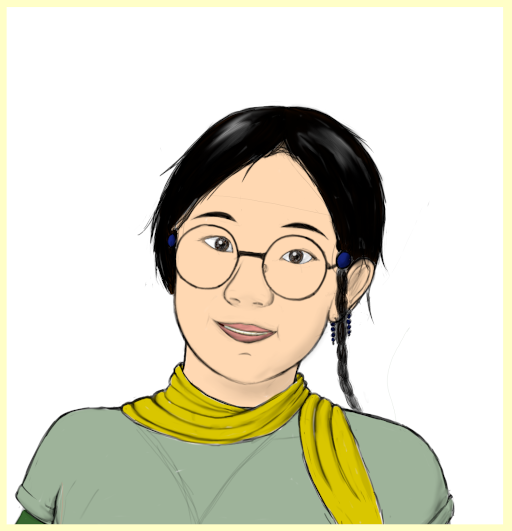
Mukushen is tall for her sex, race and age, standing 167 cm tall. She weighs 65 kg. She has decent muscular development and good physical strength, a robust constitution, and is considered conventionally attractive, but not outstandingly so, by the standards of her culture. (The standards of the Central Earth Kingdom are less favorable to her build.) She is of mostly ethnic Yonggan descent, though she has Central Earth Kingdom and Ganjinese ancestors as well, notably being a distant descendent of Qin the Great and the Ganjinese princess Chundu. She is roughly 1/8th Ganjinese, and 7/8ths Yonggan. Although her complexion is similar to Central Earth Kingdom people, she has brown eyes, in visual distinction to most of them and in common with most Yonggan. She has straight, dark hair which she keeps short except for two long cue-like braids, one on the left and one on the right.
She has three piercings in each ear, in which she wears small jewelry, of gold and lapis lazuli.
Mukushen is somewhat nearsighted and wears glasses.