<<Card: execution failed [local variable 'page' referenced before assignment] (see also the log)>>
The Yonggan (勇敢, written with characters suggesting "Brave [People]" in the Central Earth Kingdom language but actually a loanword of a Yonggan language endonym) are a people of the northern Earth Kingdom, originally nomadic pastoralists like the Abka, who have now mostly adopted a settled, agrarian lifestyle. They are organized into various clans, one of which, the Nara Clan, lives in the Hanwang desert.
Origins
The Yonggan are thought to descend, at least partially, from the Alarame people of the Northwest, who flourished during the Di and Tu dynasties. Their mythic history is set out in the Barutugisun, an early-modern national epic derived from oral traditions.
The Yonggan languages are distinctly related to the Abka languages and differ significantly from those of the rest of the Earth Kingdom; the Yonggan and Abka also share a significant number of cultural and religious traditions. It is believed that the Yonggan were originally also nomads, but became gradually more settled over the course of the 12th-9th centuries BG. The Abka displaced them from the steppe as they mastered mounted archery; the Yonggan on the other hand expanded into the foothills and mountain regions shunned by the Akba, developing their earthbending and practicing badgermole husbandry. They also developed more peaceful relationships with the nearby Earth Kingdom and its allied polities such as the Gan Jin, whereas the Abka mostly continued to raid these settled communities.
The Great Ri
A Yonggan conquest dynasty, the Great Ri Empire, ruled the Earth Kingdom from 788 to 620 BG, with a rump state remaining in the North until 579 BG, when it was conquered by the new indigenous Hao Ting dynasty based in Ba Sing Se. The Ri imperial family were of the Nara clan, and descended from a Nara khagan of the Yonggan, Jaikan. (Indeed, 日 Ri is a translation of the Yonggan language word 納喇 Nara, both meaning "sun.")
Language
The Yonggan language is related to the Abka language, and their grammar is fundamentally similar. There is a common stratum of words relating to nomadic life, and everyday words, that are clearly cognate with their Abka counterparts; morphological rules are also the same. A second stratum of words, mostly relating to settled life, technology and trade, are loanwords from Ganjinese and old Northern Earth Kingdom dialects. More recent loanwords come mostly from the Ba Sing Se dialect of the Central Earth Kingdom language.
There are three major dialects of Yonggan: Western, Nara (also called "Southern", "Central" or "Imperial") and Montane (also called "Eastern.") All are mostly mutually intelligible. The Nara dialect contains more Earth Kingdom loanwords, mostly for administrative and ritual concepts, but some of these are words for everyday concepts that have supplanted indigenous Yonggan-Abka words. The Western dialect is similar to the Nara dialect, as they only began to diverge from the Nara when that clan was banished to the Hanwang Desert after the Earth Kingdom Civil War. However, the Nara dialect does also have a stratum of loanwords from the Beetle-helmet People and sandbender tribes, and its phonology has been influenced by this linguistic contact. Despite the Western Yonggan lands being closer to the steppe, the Eastern dialect is actually the most similar to the Abka language, though they are not immediately mutually intelligible.
The Yonggan language is not a tonal language, distinguishing it from the Earth Kingdom languages. It has its own alphabetic script, but is often written with a selection of the common phono-ideographic characters used by the Earth Kingdom languages. There is nowadays a standard set of these characters used to transcribe Yonggan words. As there is not at all a perfect correspondence between the native phonetics of these languages and those of Yonggan, some characters that have the same pronunciation when used in the Earth Kingdom language would properly be pronounced differently when used in this standardized transcription. Before the development of this standardized transcription, the characters chosen for writing Yonggan names and other words in the Earth Kingdom script were chosen from among characters with appropriate phonetic readings according to the preferences of the transcriber. Often, characters with pleasant or auspicious meanings were chosen, but sometimes there were very few characters with the right pronunciation, and Yonggan names thus also include characters for random things like "warehouse," "nap," or "tin metal."
Overview
History
Antiquity
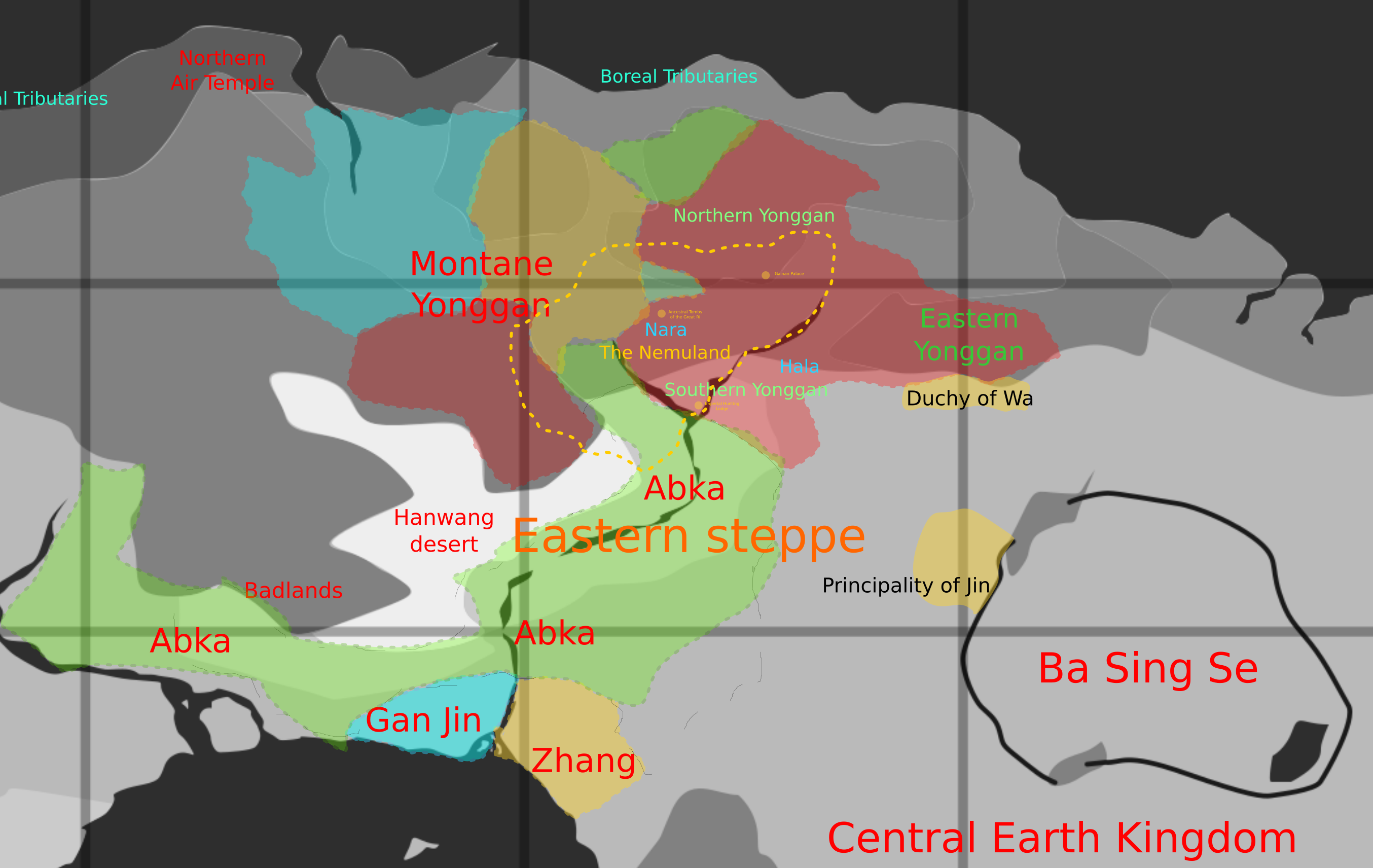 Historical Distribution of Yonggan groups and selected other groups at the beginning of the Ri dynasty.
Pre-War
Since the War
Physical Anthropology
The Yonggan have an appearance intermediate between the Abka and other Western peoples of the Earth Kingdom, and the people of the Central Earth Kingdom. In common with the Abka and some Si Wong and Hanwang tribes, they mostly have brown eyes, though hazel or green eyes are more common among the Nara than other Yonggan clans due to admixture with Central Earth Kingdom stock. Their skin color is typical of the medium-light Earth Kingdom ethnic groups (Fitzpatrick II-III classification, leaning more toward III.)
Distribution and Population
Most Yonggan are found in the Yonggan State, though large populations also exist in the State of Yi. The Nara Clan are banished to the Hanwang Desert in the Abka State, and many other Yonggan also live there. Substantial minorities exist throughout the mountain west and north, and Chenbao. A Yonggan minority exists in Omashu, which has a district called "Little Gainan;" this community was established after the fall of the Ri dynasty and saw a second wave of migration during and after the Earth Kingdom civil war. Yonggan yimin also settled in a village near Kyoshi Island, though they intermarried with Zhongzu and Ganjinese supporters of Qin and lost their distinctive ethnic identity.
Culture
Language
The Yonggan have their own language, of a completely different linguistic stock from Common. As an Abkic language, it shares grammatical and vocabulary features with the language of the indigenous people of the State of Yi, the Abka language, and the Nogai language. The Abkic languages are not tonal and have many consonants permitted in the codas of syllables, and they have agglutinative morphology; these characteristics distinguish them from Common.
Many Yonggan do speak and read Common, almost universally in urban areas, but in remote regions of the Yonggan State and the State of Yi, it is certainly possible to find whole Yonggan communities with only one or two Common speakers.
The Yonggan language has its own phonetic, alphabetic script. It can also be written in Common characters, and this was its original writing system. For most word stems, the Common character with the corresponding meaning is used. For grammatical affixes and other morphological components with no equivalent in an analytic language such as Common, certain obscure characters are used conventionally, generally chosen for their approximate phonetic value. Occasionally, and especially for rendering names, Common characters are used for their phonetic value alone, with meaning being a secondary consideration.
Yonggan observe a weak naming taboo, insofar as it is considered inappropriate to name a baby after a living or recently deceased relative, but it is acceptable (and common) for them to reuse the name of a distant ancestor.
Literature and Folklore
The Yonggan inherit a rich oral tradition, vested in their storytellers. Since the development of writing, though, they have also written much of it down and further developed a canon of literature. Notable works include the Yonggan national epic the Barutugisun, and clan chronicles such as the Naraejebun (of the Nara Clan). Much later Yonggan literature builds on these works rooted in oral tradition, for example, the Sargangisun is a "prequel" to the Barutugisun written in the late Ri Dynasty.
The Yonggan also have a tradition of historiography, which became well-developed through contact with the Common literate culture in the 800s BG forward. The Qin Dadi Waishi, an unofficial history of Chin the Great, is attributed to the Yonggan writer Ba-Yanja Sayin, a member of one of the minor lowland clans of the Nemuland whose family fled to Omashu during the Earth Kingdom Civil War.
Arts and Music
A musical instrument peculiar to the Yonggan is the badgermole horn, a woodwind instrument originally developed to communicate with underground badgermoles.
The Yonggan practice calligraphy in their own writing system, as well as having a distinctive "Yonggan Style" for Common calligraphy.
Cuisine
The agricultural products of the Yonggan homeland largely determine traditional Yonggan cuisine. Being more settled than the other Abkic peoples, agricultural products are more important than wild game, but game is still important on traditional feasting holidays. Except for the far southeast of the country, Yongganguo is either too dry or too cold for rice to be competitive with other grains; wheat and millet are grown in the south, with more sorghum and barley in the north. Most of the grain is made into dumplings and bread, especially frybread. The Yonggan make use of badgermole dairy products, but these are considered delicacies rather than staples. The assgoat and pigdog are important dairy and meat animals for the Yonggan as with other peoples in the region; the meat of the badgermole is taboo. Persistent lactose tolerance is more common among the Yonggan than the general population of the Earth Kingdom.
Yonggan food tends to use different spices, and to use them less liberally, than the Southern and Central Earth Kingdom. An exception is the Nara clan, who became more accustomed to spicy food during the reign of their conquest dynasty in Ba Sing Se. Fish is a significant part of the diet of lowland Yonggan, where available.
Religion and Holidays
Most Yonggan follow their traditional shamanistic religion, which has no central authority and has substantial variation. Each of the major clans has a priestly lineage which is passed down matrilineally. The shamanistic houses are either mantic (focusing on divination and spiritual communication rituals) or mediumistic (focusing on spiritual possession and travel to the spirit realm.) Both kinds of houses also practice herbalism, midwifery, and so forth. Shamanistic houses typically have secret initiatory lore.
During the ascendancy of the Nara Clan, and in particular as their court shamans interacted with Central Earth Kingdom state religion and the religious folkways of their conquests, the Vast Sky Orthodox Religion, i.e. the State Religion of the Great Ri, developed. As it matured, it also accrued significant influences from the religious thought of the Cardinal Air Temples. Nowadays, most Yonggan shamans consider this to have been heretical, though some ideas from the State Religion have propagated back to the traditional religion.
Politics
The Yonggan have generally been represented by some manner of Yonggan State, whether it was a tributary khanate to the Abka, a tributary to the Earth King in Ba Sing Se, or an organic part of the Earth Kingdom.
Traditionally, each of the nine major clans has had a khan, and among them one was also the khagan (khan-of-khans). Sometimes, the khagan was instead an Abka, and conversely, during the Great Ri, the Yonggan khagan was the "supernal khan" of the entire Earth Kingdom, and recognized as such by his various nomadic vassals.
The Yonggan khagan is nowadays elected by the grandees of all of the major and minor clans in an assembly. The khaganate was held by the Jala clan until they were replaced by the Nara clan shortly before the founding of the Ri. After losing power in Ba Sing Se, the Nara clan continued to dominate the khaganate until the Earth Kingdom civil war, after which they were exiled by the victorious Hao Ting. The khaganate returned to the Jala clan briefly before reforms during the Hao Ting renaissance imposed elections. Since then, it has mostly been held by the Emoto clan, who hold the khaganate at present. The Yonggan khagan, since 85 AG, is Sakda-Emoto Dorgon khan. In theory, his position is spiritual and ceremonial, and he must obey the Earth Kingdom's appointed governor in temporal matters, but lately, the khagan has been more concerned with the views of the Yonggan nationalist warlord Gioro Emoto Dabciku, who is also his son-in-law.
Life Events
The Yonggan nobility practice arranged marriage and, sometimes, polygamy, but monogamy is the norm except among the high nobility. Betrothals for arranged marriages are usually around the beginning of puberty, but customs vary; the expectation is that the actual marriage will take place in the late teenage years. Among the common people, arranged marriages are still common, but long betrothals are not, and non-arranged marriages are accepted.
Funeral customs have been influenced by Earth Kingdom folk religion, overlaying a substrate of traditional shamanism. The Air Nomad religion has also influenced elite funerary practices since the days of the Great Ri, though the extent of this influence varies among the clans and by social class.
High status funerals are marked by a formal procession from the place where the body has been prepared to a place of interment, with the deceased transported in a heavily ornamented catafalque, carried on poles by bearers. The procession also contains a number of musicians and chanting monks. Monks remain with the body from the death until its internment, chanting exhortations to the departed soul.