|
Size: 9515
Comment:
|
Size: 9516
Comment:
|
| Deletions are marked like this. | Additions are marked like this. |
| Line 4: | Line 4: |
| <<Card(EKP Yonggan State|勇敢國|type=Appointed Governor|region=West|subregion=Mountain West|status=Nationalist and Warlord Activity, Tribute interrupted)>> | <<Card(EKP Yonggan State|勇敢國|type=Appointed Governor|region=West|subregion=Mountain West [[attachment:yonggan_highlight.png|{{attachment:yonggan_highlight.png||width=300}}]]|status=Nationalist and Warlord Activity, Tribute interrupted)>> |
| Line 6: | Line 6: |
| [[attachment:yonggan_highlight.png|{{attachment:yonggan_highlight.png||width=300}}]] |
The Yonggan State (Yongganguo) is a constituent polity of the Earth Kingdom, located in the northwesternmost part of the Western Region of the Central Continent. It is the national homeland of the Yonggan people.
<<Card: execution failed [local variable 'page' referenced before assignment] (see also the log)>>
The Yonggan State, highlighted in red, on the Central Continent of the Earth Kingdom. (de jure boundaries shown)
Overview
History
Antiquity
Originally an independent khanate, sometimes a tributary of the Abka khagan, its borders have shifted over time with the political fortunes of the Yonggan and the relative strength of the state centered in Ba Sing Se. The Alarame People, one of several predecessors of the Yonggan, Nogai, and Abka, intermittently recognized the Earth King as their overlord since the late Di dynasty, though their territory was not an organic part of the Earth Kingdom until the Tu. The Yonggan State, by that name, was formally created in the Di dynasty. Although still designated as a guo (國), it has been a directly-governed province since the Earth Kingdom Civil War.
Before the War

Territories of some principal Yonggan clans at the time of NARA Boosi, ca 800 BG. (The two Eastern clans are not shown.)
After being reduced in size by the Hao Ting after the Yonggan support of Qin the Conqueror, the de facto boundaries of the state have expanded again in the past few decades, as ambitious local leaders have gained effective control over Yonggan-majority areas from neighboring jurisdictions. The central government, preoccupied with the Fire Nation invasion, has not taken any effective action to reverse this, and the scholar-official appointed as Governor by the Earth King appears to be subordinate to a Yonggan nationalist warlord, Gioro Emoto Dabciku. No taxes have been remitted to Ba Sing Se since 72 AG.
Since the War
Climate, Geography and Biology

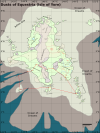
Map of the modern Yonggan State.
Economy
The economy of the vast mountains and forests of the Yonggan State is focused on the primary industries and subsistence farming, but it has secondary and tertiary economic activities focused in the cities and towns.
Agriculture
As most Yonggan are nowadays settled agriculturalists, agriculture is a major sector of the economy. In the south, wheat is the main crop, followed by moderately cold-tolerant northern millet, whereas short-season cultivars of barley and sorghum are the main crop in the north. Rice cultivation is minor, for several reasons: first, most of the country is either too dry or too cold for it to be competitive with other crops; second, the largely hilly terrain would require terraces for flooded rice cultivation, an expensive measure which the low population density and relatively short growing season do not justify even in a country with abundant earthbending talent.
The badgermole, though it is of great cultural and military importance, is only a minor source of food: its dairy products are consumed as a delicacy, but its meat is taboo to the Yonggan, and badgermole slaughter is illegal; the slaughter and consumption of war badgermoles by the victorious Hao Ting troops after the surrender of Gainan is still widely remembered. In spite of the present political difficulties between the dynasty in Ba Sing Se and the local rulers of Yongganguo, trained badgermoles are still sold to the Royal Earth Army under the auspices of the khaganate. They are also sold to warlord armies the khagan considers friendly.
The main animals grown for food and textiles are the assgoat, pigdog, and wooly riverpig. Sometimes the latter animal is kept in earthbent ponds fed by small mountain streams, greatly extending the area in which it can be maintained; the ponds must be provided with winter shelters in which the animals can hibernate out of the ice. The assgoat is favored for dairy and fiber, but its meat is also eaten. It is sometimes used as a pack animal, especially suited to mountains, though the mulegoat is preferred. In lowland areas, the ostrich horse, usually hardy Abka breeds, are better pack and riding animals.
Industry
Metalworking is well developed, including mining, smelting, refining, casting, forging, smithy in a variety of metals, and fine artistic metalwork. There is a nascent chemical industry, and a small but diversified selection of other industries such as tanning, charcoal-making, ceramics, and woodworking.
Trade
Transportation
Culture and Anthropology
Ethnic Composition
Languages Spoken
Cultural and Religious Institutions
Arts, Fashion and Cuisine
Subdivisions and Politics
Yongganguo is, in the eyes of the Earth Kingdom government in Ba Sing Se, divided into various counties with appointed officials administrating civil matters. In practice, however, these jurisdictions are relevant only in towns; the countryside is administered almost entirely under Yonggan customary law. Even in the towns, Yonggan people rarely bring disputes with other Yonggan before the Earth Kingdom yamen, preferring to resolve their differences within the framework of traditional clan and family power structures. Each khan holds a court in concert with his head shaman and elders, to which any clan member might appeal if local dispute resolution fails.
Each clan has traditional territories, but their borders are subject to gradual evolution as families prosper, decline, and intermarry; the borders are associated with individual family grazing, hunting, mining, and agricultural rights.
The khagan of the Yonggan is Sakda-Emoto Dorgon khan, who also leads the Emoto clan. In theory, the khaganate is a ceremonial and spiritual office since the imposition of direct rule by Ba Sing Se after the Earth Kingdom civil war. During the Hao Ting renaissance following that war, the khagan rubber-stamped decisions of the appointed governor in temporal matters. This has no longer been the case for some time, however, and under Dorgon khan the civil official has been largely sidelined. The khagan has returned to a position of active political involvement, and has been cooperating with his son-in-law, the Yonggan nationalist warlord Gioro-Emoto Dabciku.
Dabciku expanded the territory of the Emoto clan by occupying lands belonging to the Abka state, but which were majority Yonggan. The clan armies, operating under the direction of the khagan, also occupied Yonggan-majority parts of Angxue and the State of Yi, and parts of the West Shuizu state that were historically Yonggan lands before the civil war. The warlord Dabciku has also expressed designs on portions of the Western Plains Province and North Mountain province which were formerly part of Yongganguo, even though those areas are no longer Yonggan-majority.
The country is not currently remitting taxes to Ba Sing Se, and has not since Dabciku married Dorgon khan's eldest daughter and was appointed the khagan's grand marshal. Since that time, the already-minimal tax payment that had been collected (chiefly from urban areas of mixed ethnic composition) has gone to Dabciku's Yonggan nationalist army.
Capital
The legal capital of the Yonggan State is Garunggu, on the Elephant Lake near Qin's Bridge, in the East of the country. Historically, from the Nara ascendancy to the Earth Kingdom civil war, the capital was in the mountain city of Gainan. After the war, the native elite were banished from Gainan, and mostly-Zhongzu veterans settled there. The administrative capital was moved to Garunggu, and the appointed governor's yamen remains there to this day. Formerly, the Yonggan Khagan was obliged to reside in Garunggu for much of the year, but in 80 AG, the khagan has moved his court to Emotofuke, a new capital built in territory formerly held by the Nara clan, at the foot of the Orpiment Mountain. Emotofuka can be considered the de facto capital. The nationalist warlord Dabciku makes the city of Funghuwang his base of operations; it is located in the newly-annexed lands of the Rong river valley, Southeast of the Hailun mountain.
Governance
Yongganguo is mostly governed under Yonggan customary law, as noted above. In the cities, Earth Kingdom royal law has some influence, especially between non-Yonggan, and officials continue to be sporadically appointed by the Board of Appointments in Ba Sing Se. However, taxes are not being regularly remitted and there is substantial nationalist activity. What is more, the local leadership is actively occupying and annexing parts of neighboring polities on ethnic lines; in times of stronger central governance, the state would surely be considered to be in rebellion. However, the central government is, as yet, too occupied with the Fire Nation invasion and other problems to reassert itself in Yongganguo.